
Understanding contrast
Hopefully by now you’ll have some understanding of what contrast is, thanks to what we’ve learned in the first few weeks of the membership.
We looked at contrast when we were trying to figure out our colour season, but contrast also comes into play when we’re thinking about the colours that look good on us, and how we can use it to build outfits that feel great on us.
In essence, contrast is simply the difference between light and dark. The bigger the difference, the higher the contrast.
When we talk about contrast in personal styling, we’re interested in how much difference there is between the colours you’re wearing, and how that compares to your own natural colouring.
I actually find that one of the biggest reasons an outfit can feel “off” on me now is when the contrast isn’t quite right.
As a Winter, my natural contrast is high. I have very pale skin and dark hair, so there’s a big difference between the lightness and darkness of my features.
Because of this, I generally feel best when I have some contrast in what I’m wearing too.
Sometimes, when I’m wearing an outfit with very little contrast, I can feel a bit… flat. There’s nothing necessarily wrong with the colours themselves; they just don’t have enough difference in light and dark to reflect my own natural colouring.
Interestingly, this is also one of the reasons I think I can sometimes feel a bit flat when I drift into wearing more summer outfits. It’s not necessarily that the colours are “wrong”, they can be beautiful, but many Summer colours are softer and more muted, and they can naturally create less contrast than my high-contrast colouring is used to.
And this is where understanding your own contrast becomes really useful.
The aim is to create a level of contrast in your outfits that feels harmonious with your own natural colouring.
You already know your contrast
You should already feel pretty confident about your natural level of contrast, and if you don’t, come and ask in the group!
We worked this out earlier in the membership when we were looking at your colour season, so this isn't about working it out again.
Instead, I want you to start thinking about how you use contrast in your outfits.
Your natural contrast is essentially the relationship between the light and dark elements of your own colouring, your hair, skin and eyes.
And the general idea is that we tend to look most harmonious when the contrast in our outfits reflects the contrast in our natural colouring.
If you have low-contrast colouring, you’ll probably find that softer, more tonal outfits feel particularly harmonious.
If you have medium-contrast colouring, you can generally create a noticeable difference between light and dark without needing an extremely dramatic combination.
And if you have high-contrast colouring, you can generally carry much stronger differences between light and dark.
Seeing contrast
Here's a really simple way to see what we're talking about:
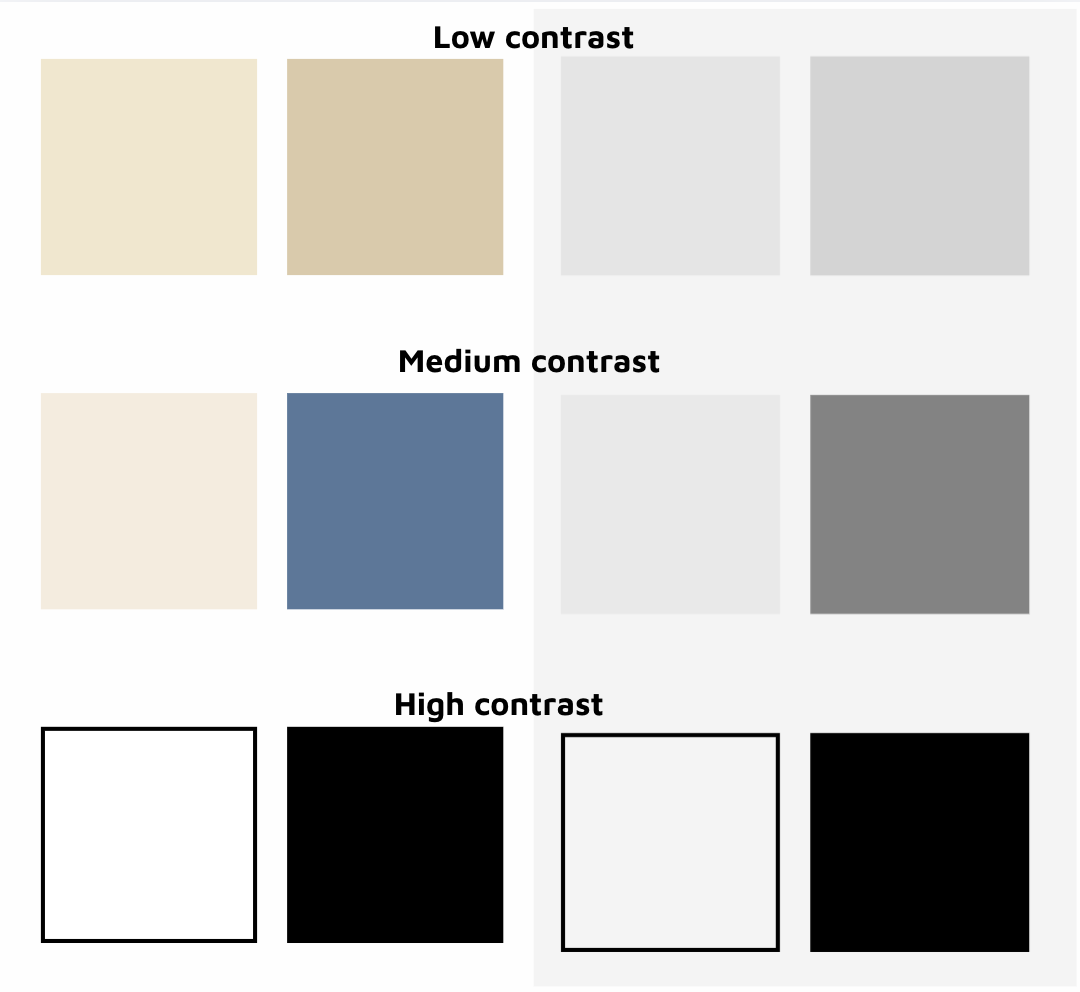
On the left, you can see the colours. On the right, I've turned them into greyscale.
I've done this because when we take away the colour, it's much easier to see how light or dark each colour is.
The first example has colours that are very similar in lightness, so it has low value contrast.
The second has a bigger difference between light and dark, so it has medium value contrast.
And the final example has a very big difference between light and dark, so it has high value contrast.
Contrast is one of your styling tools
So how can we use this when we're getting dressed?
Imagine you have a cream top. You could wear it with beige trousers. Because the two colours are quite similar in lightness, this gives you a low-contrast outfit.
Now swap the beige trousers for mid-blue jeans. There's a bigger difference between the cream and the blue, so you've created more contrast. And if you wear the cream top with black trousers, you've created a high-contrast outfit because there is a very big difference between the light and dark colours.
The clothes haven't really changed. We've simply changed how much difference there is between the light and dark colours. But that small change can make the whole outfit feel different.
This is why I want you to think of contrast as one of the tools in your styling toolkit. It's not another rule telling you what you can and can't wear.
You might want a soft, tonal outfit where the colours blend together. Or you might want something that feels bolder and more defined, with a bigger difference between light and dark.
Neither is better or worse. They're just different.
So what works for you?
This is where your own natural contrast comes in.
If you have low-contrast colouring, you may find that outfits with colours that are close together in lightness feel the most natural on you.
If you have medium contrast, you might enjoy a noticeable difference between light and dark.
And if you have high contrast, you might find that stronger differences really make your colouring stand out.
But you can absolutely choose to wear a different level of contrast too.
For example, someone with naturally low-contrast Summer colouring might deliberately add more contrast because they want their outfit to feel a little more edgy, dramatic or modern. It might not be the most naturally harmonious choice for their colouring, but that doesn't mean it's wrong. It simply creates a different effect.
And you don't have to create contrast with your main clothes either. Accessories are a really easy way to add or soften contrast.
If you're wearing a fairly tonal outfit of cream and beige but want a little more definition, you could add a darker belt, bag or pair of shoes, or use a brighter accessory as the pop of colour we often talk about. Equally, if you're wearing an outfit with lots of contrast but want to soften it, you could choose accessories that are closer in lightness to the rest of your outfit.
And I guess that's really the point of today's Joy Drop. Contrast might not be something you've thought about before when you're getting dressed, but it could be affecting your outfits more than you realise.
You might have an outfit that feels a little flat and not be able to put your finger on why. Or you might put something on and instantly feel like it really works, without knowing exactly what it is that makes it feel so good. The amount of contrast in the outfit could be part of the reason.
Contrast is a styling tool, not a rule.
You might love a soft, tonal outfit one day and want something much more contrasting the next. It can depend on your mood, where you're going, or simply how you want to feel that day.
Once you understand contrast, you can start using it on purpose rather than accidentally.
And that gives you another way to make your wardrobe work harder for you (which we always love.)
Related JoyDrops:
If you want more Summer JoyDrops then take a look at these: